Overmind JournalAutomation
Give Your Voice Hands.
How Voice Intelligence connects spoken requests with practical industrial tasks, clear responsibility and reliable results.
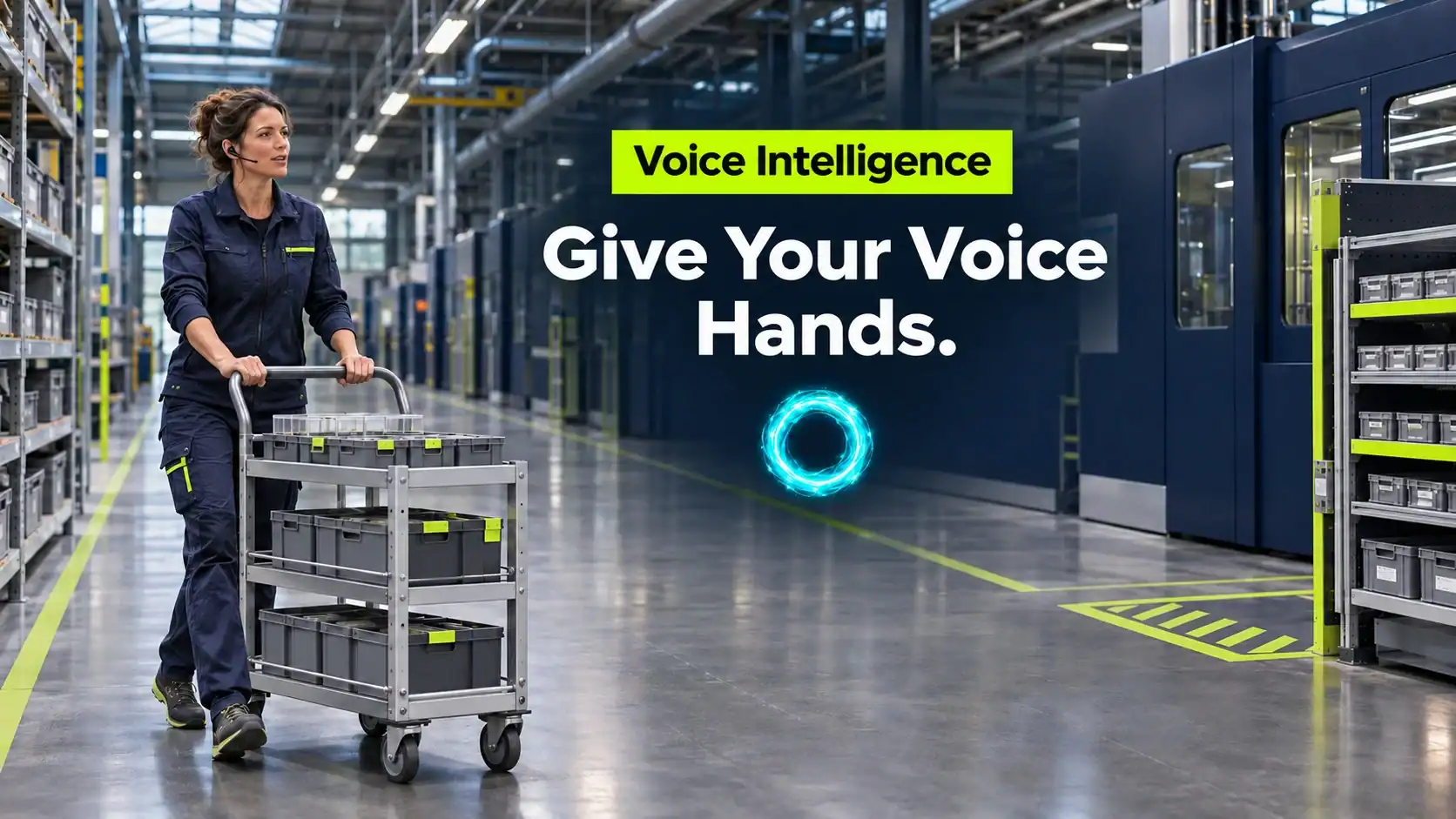
An employee is standing at an assembly station. An assembly lies in front of her, and she is holding a component. A seal kit is missing for the next work step. She knows the order, the material required and the place where the part is needed. Now that information must reach the right people and systems.
She says: “A seal kit is missing for this order. Check stock and request replenishment.”
That sentence contains a complete request. Turning it into a reliable process means identifying the order and material unambiguously, checking permissions, submitting the request and reporting the actual status.
When a request becomes an action
This is where Voice Intelligence gains hands. Those hands represent the ability to carry out an action in connected systems: create a material request, report a fault, document an inspection step or hand an open task over to the next shift. The person describes what is needed. An appropriately designed application translates that request into an established operational process.
Value emerges when a spoken request reliably becomes part of the work process.
Speech is particularly useful when people need to keep their attention on a practical task. How well the interaction works depends on the task, the acoustic environment and the design of the application. For Overmind, the Voice Operating Layer provides the conceptual framework for connecting human communication with knowledge and operational processes.
Request materials and know the actual status
A possible dialogue at the assembly station could look like this. The identifiers and reference numbers in this example are illustrative:
Employee: “A seal kit is missing for order 4711 at assembly station 17. Please request replenishment.”
Voice: “The order uses seal kit D-24. Shall I request one kit from warehouse 2 for assembly station 17?”
Employee: “Yes, request it.”
Voice: “Material request M-208 has been created and passed to intralogistics. Delivery has not yet been confirmed.”
This example connects communication with a concrete action. The employee learns which material was requested, where the request went and what remains open. Once intralogistics confirms that the material is ready, the process can receive that new status.
It also shows what a good voice application must do: distinguish between understood, prepared, submitted, accepted and completed. A friendly “I’ll take care of it” offers little certainty in everyday industrial work. People need a reliable status on which to base their next steps.
Bring observations into maintenance
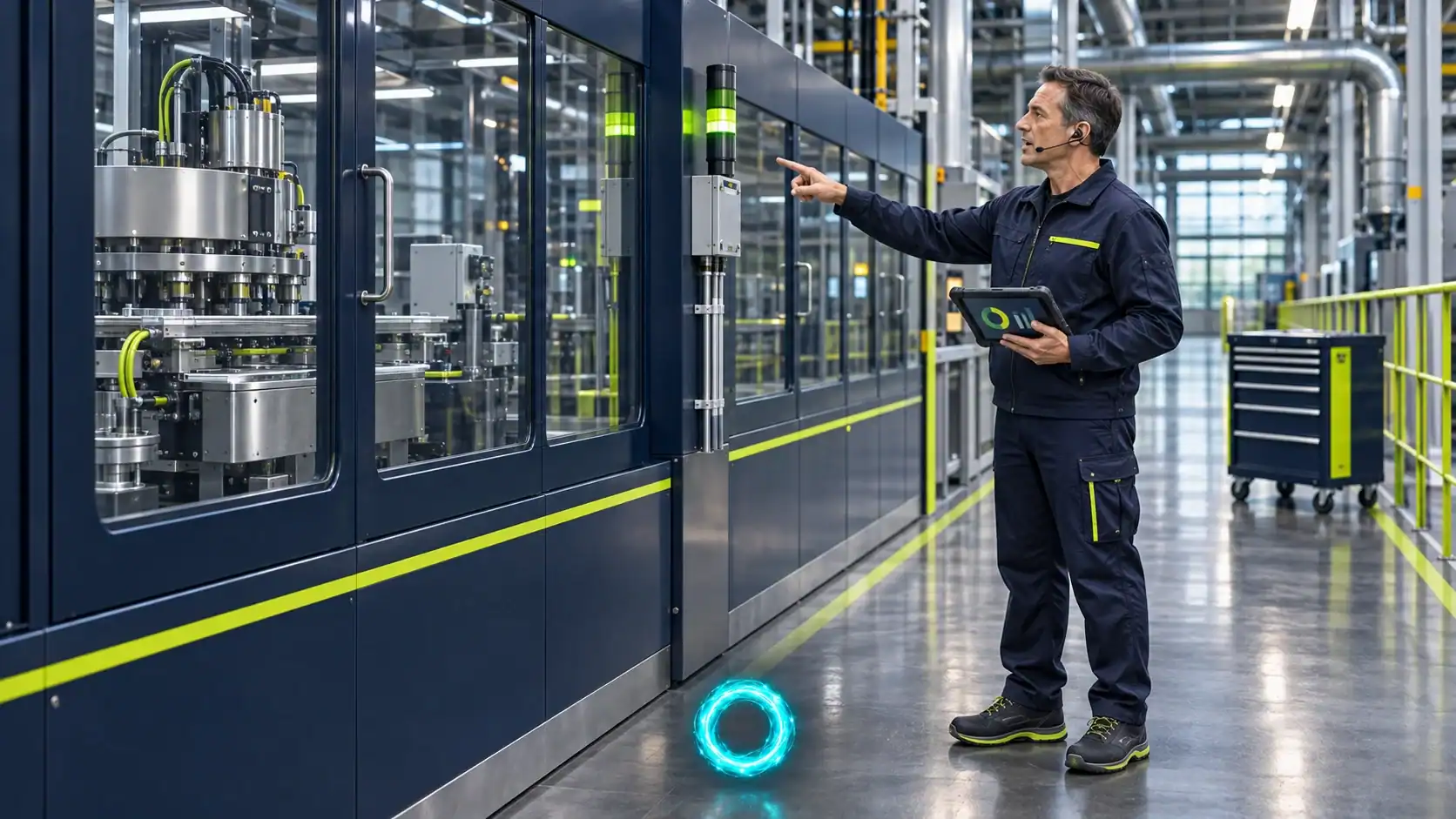
The same principle applies to maintenance. An employee notices unusual scraping on a conveyor and reports: “The right-hand guide on conveyor F12 has been scraping since the last container change.”
A suitable application asks for the information still needed to handle the issue. When was the problem first noticed? Is the equipment still operating? Is there already a related work order? It can then create a structured report in the maintenance system and pass it to the responsible team. The person making the observation receives a reference number and a traceable processing status.
The professional observation remains an observation. A reported sound must not become a supposedly certain diagnosis. Voice Intelligence helps people bring their observations into the process fully and promptly. The responsible specialists carry out the investigation and assessment.
Speech can also enable a precise system action after work has been performed: “Bearing on pump P24 replaced. Test run still outstanding.”
This short update contains two different states: a completed activity and an open check. A thoughtfully designed application records them separately. It assigns the information to the correct order and confirms what was actually documented. The order remains open under the established procedure while required steps are still missing.
Make quality processes and shift handovers traceable
In quality assurance, a similar process might begin with: “Three parts in batch B17 have surface damage.”
Voice can help capture the batch, affected quantity, inspection characteristic and observation. The people responsible for quality receive the case with the necessary details. The existing quality process, with its responsibilities and approvals, determines the next steps, such as an additional inspection or a formal hold.
An irregularity can therefore move directly from the work situation into a case that someone can act on. At the same time, it remains clear who observed it, who assessed it and who made a decision.
This connection can be particularly valuable during shift handovers. “The guide on line 3 must be checked after the next batch change” describes a task with a specific trigger. A voice application can associate the note with the equipment, assign a responsible role and include it in the established handover process. The next shift can see what is due and confirm that it has taken over the task.
This creates a traceable connection between people working at different times. The outgoing shift can see whether the information was passed on and whether someone has accepted responsibility for the task.
Start with useful individual tasks
These applications should begin with a manageable scope. Even one well-chosen action can help in everyday work: open the relevant work order, create an internal material request, record an inspection result or check the status of a fault report.
For each task, it is possible to specify the required information, who may perform it and how successful execution can be recognised. Several proven individual tasks can then form a connected workflow. A fault report might lead to a specialist review, work planning and, later, a documented completion update. Every step has an owner and a verifiable state.
Integration, permissions and clear feedback
Voice Intelligence therefore needs a connection to operational reality. Equipment identifiers, material numbers, order statuses and valid work instructions must come from the responsible systems. Interfaces to production, maintenance, quality or inventory management systems provide the foundation. The appropriate integration for a particular process must be established in each project.
Clearly defined actions are equally important. A language model can help interpret a request. Subsequent execution should be limited to specified functions with validated inputs. Which material number is meant? Does the unit match the quantity? Is the person authorised to make this transaction? Is the order still current?
The confirmation required depends on the consequences. A status query can receive an immediate answer. A binding transaction or a change with significant consequences needs an appropriately designed check and approval. A familiar voice alone does not establish authorisation.
Reliability also shows in the handling of interruptions. If the connection fails during a material request, the application must later be able to determine whether the request was already created. Repeating a spoken request must not silently create a duplicate. If the state remains unclear, that uncertainty must be visible to the person.
Interaction must fit the workplace
In an industrial environment, this includes a clear boundary between assistance and machine safety. Reports, requests and documentation tasks offer suitable starting points. Actions affecting machine movements or process parameters require an overall solution specifically designed and assessed for that purpose. Technical protective measures and required approvals remain decisive.
The interaction must also fit the workplace. People speak with different accents, use local shorthand and work under changing acoustic conditions. Material numbers can sound alike. Several people may speak at once. Introduction therefore includes testing at the actual point of use, with the employees involved, their protective equipment, the technical terminology and typical background noise.
The application must ask when information is ambiguous. A scan may be more appropriate for a long identifier; an image may help explain a spatial relationship. Speech can be combined with these approaches. What matters is that people can complete their task clearly and reliably.
Introduce it together and prove it in daily work
For Overmind, this is a central design task: embedding Voice Intelligence in industrial work so that human communication leads to traceable actions. Specific processes are examined together with employees. Where does an observation get lost? Where does a request receive no feedback? Where is the same information entered repeatedly? Where is a clear next step missing? The Voice Intelligence in practice section explores further industrial contexts.
A sensible starting point is a frequent, clearly bounded process with manageable consequences. Production, maintenance, IT and the employees concerned jointly define what Voice may execute and how the result is checked. Experience in everyday work then matters: Are reports more complete? Are tasks accepted sooner? Are there fewer clarification requests and duplicate entries? Can people continue reliably after an interruption?
A new way of working can grow from this. Employees speak an observation where it arises. The responsible people receive a case they can act on. Systems perform defined steps and report their actual state.
Giving your voice hands means connecting the spoken word with a useful task, clear responsibility and a reliable result.
Which concrete work step would make a good starting point in your company? Discuss your industrial use case with Overmind.