Overmind Journal
Outlook: From electrical schematics to usable knowledge.
Outlook: How components, identifiers and connections in electrical schematics could become structured data—with a traceable source, version and expert review.
Outlook · A possible extension of knowledge extraction.
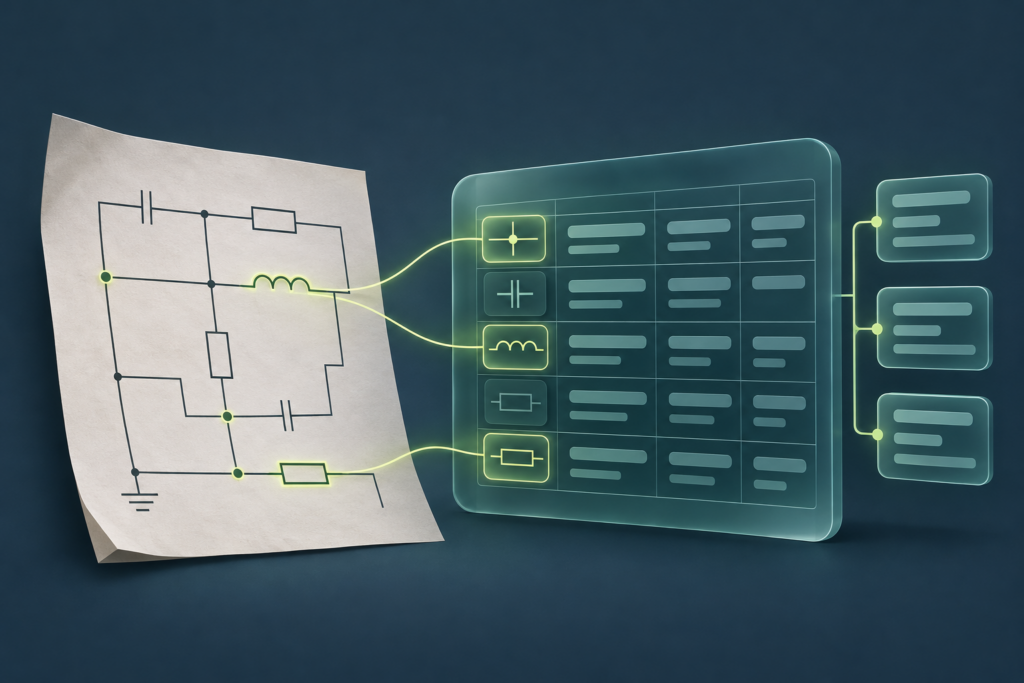
An expert looks at an electrical schematic and recognises components, identifiers and connections. To use this information in a conversation, it would need to be extracted in a form that supports targeted questions and traceable answers.
This is the starting point for an idea we would like to investigate further: electrical schematics could become structured data. This could provide an additional knowledge source for Voice Intelligence.
This outlook describes a possible development path. The data and questions shown form a simplified, illustrative example.
What could be extracted from the schematic
An initial approach would focus on clearly defined information: Which components are shown? What identifiers do they have? Which connections does the schematic show? On which sheet and in which document version can an item be found?
This information could form a data model. It would describe components and their relationships so that they could be selected, compared and reviewed by experts.
The original schematic would remain the source. For every extracted entry, it should be possible to trace where the information came from and which document version it refers to.
A simplified example
Consider an illustrative schematic excerpt with two identifiers: K1 for a contactor and X1:14 for a terminal. The example shows a connection between them.
| Field | Example value |
|---|---|
| Component identifier | K1 |
| Component type | Contactor |
| Connection in the example | X1:14 · Terminal |
| Source | Example schematic · Sheet 3 · Revision B |
| Review status | For technical review |
The information would then be accessible as individual entries. Selecting a data entry could highlight the corresponding location in the schematic. Experts could compare the identification and connection directly with the source.
Data could become a question that can be answered
After expert review and approval, it would be possible to investigate how Voice Intelligence could access this data.
One possible question would be: “Which terminal is K1 connected to?”
An answer would need to refer to the reviewed data and the relevant location in the schematic. If information were incomplete or contradictory, a follow-up question or a handover to the responsible expert would be a useful outcome.
Other questions could concern identifiers, connections or the appropriate document version. The questions supported would need to be defined and tested for the particular use case.
Review is part of the development path
For extracted data to become usable knowledge, several things would need to align: correct identification of components, traceable capture of connections and a reference to the valid document version.
A designated expert would review the results. Missing or ambiguous information would need to remain visible. Changes to the schematic would require a new review of the affected data.
For the Voice Operating Layer, this would be a possible extension of knowledge extraction through KSE. A conversation could then provide access to the reviewed result.
Explore the possibilities with a limited example
An initial trial could begin with a defined schematic type, a small number of approved documents and specific work-related questions.
It would need to establish which information can be extracted reliably and where expert rework is required. The link to the original source would also need to be traceable in the example.
This would allow the idea to be assessed step by step: from a schematic excerpt to structured data and then to a question whose answer can be reviewed and supported by evidence.